


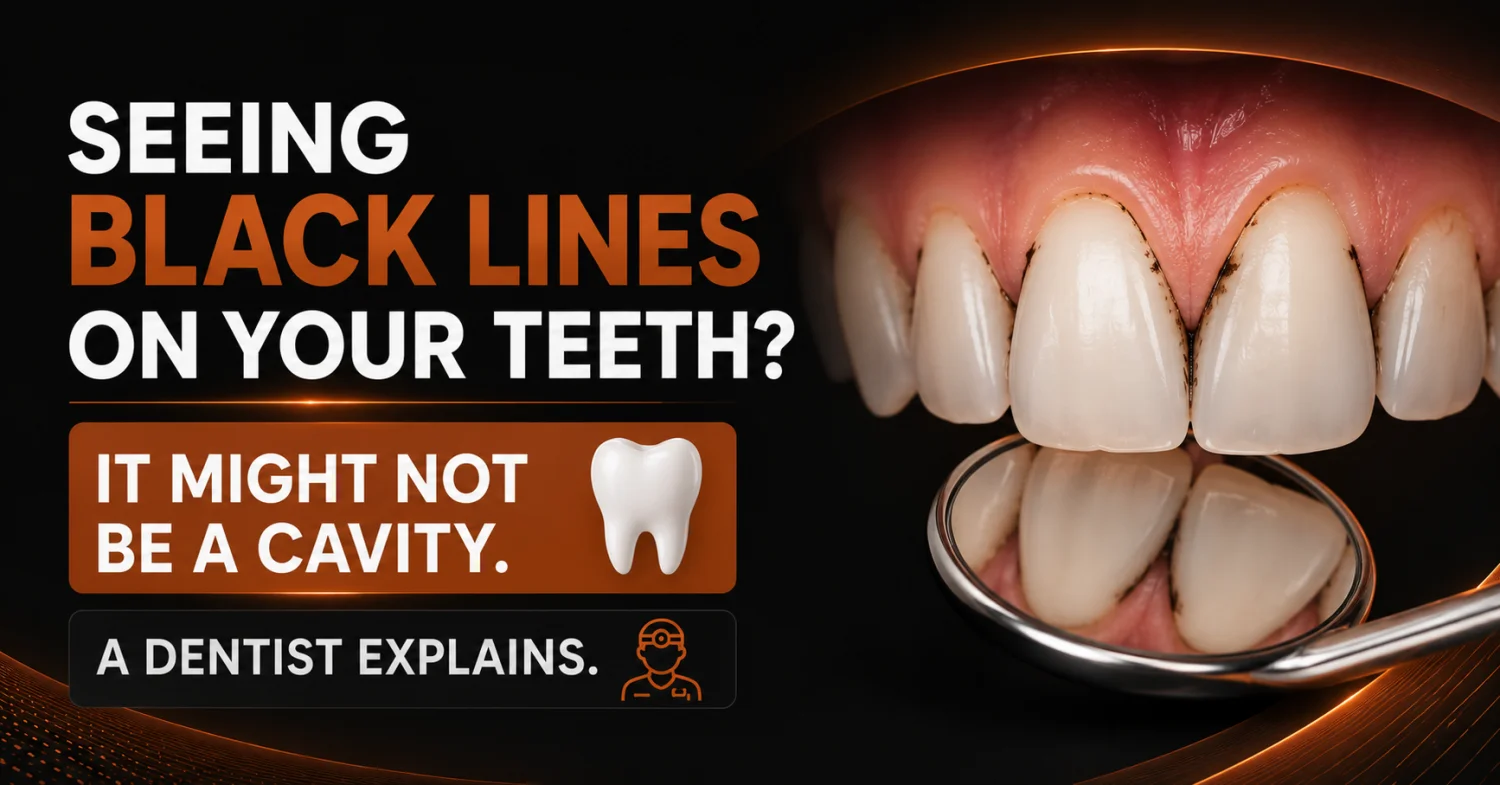
Seeing Black Lines on Your Teeth? It Might Not Be a Cavity. A Dentist Explains.

Medically Reviewed by Dr. Shashi
Table of Contents
- What are the black lines on my teeth?
- The Prime Suspect: Dental Caries (A Cavity)
- Cause #1: Extrinsic Stains (The Most Common Culprit)
- Cause #2: Tartar (Calculus) Along the Gumline or in Grooves
- Cause #3: Craze Lines (Harmless Hairline Cracks)
- Cause #4: Tooth Trauma or Injury
- Other, Less Common Causes
- The Professional Diagnosis: Why You Must See a Dentist
- Top Searched FAQs About Black Lines on Teeth
- Conclusion: Don't Panic, But Do Take Action
What are the black lines on my teeth?
It’s a common moment of unease. You're leaning into the bathroom mirror, brushing your teeth before bed, when you spot it—a fine, dark line etched into the surface or groove of a tooth. The immediate, sinking feeling is almost universal: "Oh no, a cavity." This reaction is completely understandable. We’re taught from a young age that dark spots on our teeth are a sign of decay. While a black line absolutely can be a cavity, it is far from the only possibility. In fact, many of these lines are caused by things that are far less alarming. The key is not to panic, but to understand the potential causes. An informed patient is an empowered patient. Differentiating between a harmless surface stain and an issue that requires intervention is impossible for the untrained eye, but understanding the possibilities can demystify the problem and guide your next steps. This comprehensive guide will explore the various causes of black lines on teeth, from the most common and benign to those that require a dentist's expert care. We will help you understand what you might be seeing and why a professional diagnosis is the only way to achieve true peace of mind.
The Prime Suspect: Dental Caries (A Cavity)
Let's address the most common fear first. A black line can indeed be a sign of tooth decay, medically known as dental caries. This is particularly common on the chewing surfaces of your molars. These teeth have natural pits and deep grooves (known as fissures) that are excellent at trapping food particles and plaque, making them susceptible to decay. A "fissure cavity" often begins as a small, white, or light brown spot as the enamel demineralizes. If left unchecked, the decay process continues, breaking down the tooth structure. As the decay progresses and becomes stained by foods and drinks, it can appear as a distinct black or dark brown line embedded in the groove of the tooth. Characteristics that might suggest a cavity:
- The line is located in a deep groove or pit.
- A dental instrument (used by your dentist) might feel a slight "stickiness" or softness in the area.
- The tooth may become sensitive to sweet, hot, or cold stimuli.
- An X-ray will confirm if the decay has penetrated the enamel into the deeper dentin layer.
If your dentist confirms the black line is a cavity, the treatment is straightforward and routine, typically involving the removal of the decayed portion and the placement of a tooth-colored filling. But if it’s not a cavity, what else could it be?
Cause #1: Extrinsic Stains (The Most Common Culprit)
This is the most frequent and least concerning cause of black lines on teeth that aren't cavities. An extrinsic stain is one that is on the outer surface of the tooth enamel. The enamel of your teeth, while incredibly hard, is not perfectly smooth. It contains microscopic pits, fissures, and irregularities. Over time, pigments from dark-colored foods and drinks can get absorbed into these areas and build up, creating a concentrated line of stain. Common Causes of Extrinsic Staining:
- Beverages: Coffee, black tea, red wine, and dark colas are major contributors.
- Foods: Dark berries (blueberries, blackberries), soy sauce, and balsamic vinegar.
- Tobacco Use: Smoking or chewing tobacco deposits tar and nicotine that create deep, dark stains.
- Medications: Certain supplements, particularly liquid iron supplements, are notorious for causing dark surface staining.
Because these stains often accumulate in the deepest grooves of your molars, they can perfectly mimic the appearance of a fissure cavity. The good news is that these are purely cosmetic. They do not damage your tooth structure and can typically be completely removed during a professional dental cleaning and polishing.
Cause #2: Tartar (Calculus) Along the Gumline or in Grooves
If you don't remove dental plaque (the soft, sticky film of bacteria) from your teeth regularly, it will absorb minerals from your saliva and harden into a substance called tartar, or calculus. While tartar is usually yellowish or brown, it is very porous and can easily absorb dark pigments, turning it dark brown or black.
- Black Lines at the Gumline: A common place for tartar to build up is right at the edge of the gums. This can create a distinct black line that traces the contour of your tooth. This is often a sign that you need to improve your brushing and flossing in that area and is a precursor to gum disease.
- Black Lines in Fissures: Tartar can also form in the deep grooves of your molars, creating a hard, dark line that can be easily mistaken for a cavity.
Unlike plaque, tartar cannot be brushed or flossed away at home. It is bonded firmly to the tooth and must be professionally removed by a dentist or dental hygienist using special instruments in a process called scaling.
Cause #3: Craze Lines (Harmless Hairline Cracks)
This is a very common cause of vertical black lines, especially on front teeth. "Craze lines" are tiny, shallow, hairline cracks that affect only the outer layer of enamel. They do not penetrate into the deeper, sensitive dentin layer and do not compromise the structural integrity of the tooth. Causes of Craze Lines:
- Years of normal function: The simple stress of a lifetime of biting and chewing.
- Bruxism: Habitual clenching or grinding of teeth.
- Trauma: A minor knock or blow to the tooth.
- Biting on hard objects: Chewing on ice, pens, or fingernails.
The cracks themselves are not dark. The issue is that these tiny fissures, just like the grooves in your molars, can absorb stains from coffee, tea, or smoking over time. This makes the invisible crack become visible as a fine, vertical black, brown, or grey line. For the most part, craze lines are considered a cosmetic issue and do not require treatment for health reasons. If their appearance bothers you, treatments can include professional teeth whitening to lighten the stain within the crack or, for more prominent lines, cosmetic bonding or porcelain veneers.
Cause #4: Tooth Trauma or Injury
Sometimes, a significant impact on a tooth—from a fall, a sports injury, or an accident—can damage the pulp (the living nerve and blood vessels) inside. If the pulp dies, the blood cells decompose. As hemoglobin from these cells breaks down, it releases iron, which can seep into the microscopic tubules of the surrounding dentin, staining the tooth from the inside out. This type of "intrinsic" staining causes the entire tooth to darken, often taking on a greyish or dark hue. Sometimes this discoloration can be concentrated in a way that appears as a dark line or shadow within the tooth. This is a sign that the tooth is non-vital (dead) and requires dental attention. The treatment typically involves root canal therapy to remove the dead pulp, followed by internal bleaching or a crown to restore the tooth’s natural color.
Other, Less Common Causes
- Old Dental Work: The margins of old fillings (especially silver amalgam fillings) or crowns can begin to leak or corrode over time. This can create a dark line around the edge of the restoration that looks like a new cavity.
- Developmental Grooves: Some teeth naturally form with particularly deep or prominent grooves that can stain easily and appear as dark lines from a young age.
- Black Line Stain in Children: Some children develop a specific type of dark, thin line near the gumline caused by certain types of chromogenic (color-producing) bacteria in their mouths. While it looks alarming, it is not decay and can be managed with professional cleanings.
The Professional Diagnosis: Why You Must See a Dentist
By now, it should be clear that a black line on your tooth can have a wide range of causes, from a simple coffee stain to a sign of tooth trauma. Self-diagnosing at home is impossible and can be risky. A black line that is "just a stain" can look identical to an early-stage cavity to the untrained eye. Ignoring the line and assuming it’s just a stain could allow a small, easily-treatable cavity to grow into a much larger problem requiring more extensive and expensive treatment. The only way to get a definitive answer and true peace of mind is through a professional evaluation at a leading dental clinic in Delhi. How to remove black lines in pits of molars? During your appointment, your dentist will perform a thorough diagnosis using several methods:
- Visual Examination: Assessing the location, color, and texture of the line.
- Tactile Examination: Using a dental explorer to gently feel the line. A healthy, stained groove will feel hard, while a cavity will often feel slightly soft or "sticky."
- Dental X-rays (Radiographs): An X-ray is the only way to see if decay has breached the enamel and spread into the dentin underneath.
Top Searched FAQs About Black Lines on Teeth
Can I brush away a black line on my tooth?
If the line is a very new and light surface stain, vigorous brushing might reduce it slightly. However, if the line is caused by a cavity, tartar, a stained craze line, or intrinsic staining, brushing will not remove it. Aggressive brushing in an attempt to remove it can actually damage your enamel and gums.
Are black lines on teeth normal?
While they are very common, they are not necessarily "normal" in the sense that they should be ignored. Any new or changing line on your tooth warrants a professional check-up to determine its cause.
Why does my child have black lines on their teeth?
This is often a specific condition called "black line stain." It is caused by a reaction between specific bacteria in a child's saliva and iron. It is not tooth decay and is not related to poor hygiene, but it does need to be professionally cleaned off and may recur until the child's oral microbiome changes, usually in their teenage years.
Do black lines on teeth mean the tooth is dead?
Not usually. The only time a black line indicates a non-vital (dead) tooth is when it's part of a general darkening of the tooth following a significant injury or trauma. Most other causes, like stains, tartar, and craze lines, are unrelated to the health of the tooth's nerve.
How do dentists remove black lines from teeth?
The treatment is entirely dependent on the cause:
- For Stains: Professional cleaning and polishing.
- For Tartar: Professional scaling.
- For Cavities: A filling.
- For Craze Lines: Whitening or cosmetic bonding/veneers.
- For Trauma: Root canal therapy and a crown or internal bleaching.
Conclusion: Don't Panic, But Do Take Action
Seeing a black line on your tooth is a signal to pay attention, but it is not a reason to panic. As we've explored, there are many potential causes, and most of them are not cavities. However, the importance of a professional diagnosis cannot be overstated. The path to the right solution—whether it's a simple cleaning to remove a coffee stain or a filling to stop decay in its tracks—always begins with an accurate assessment by your dental team. Don't spend your time worrying and wondering. Schedule an appointment
-
Other Blogs
- Dental Veneers: Before & After, Benefits, and Common Myths
- The Science Behind Smile Makeovers: What You Should Know
- Are Dental Implants and Metal-Ceramic Crowns Safe During an MRI?
- How Long Do Veneers Really Last?
- Why Do Dental Implants Fail? Causes, Warning Signs & How to Prevent It
- How Do I Know If I Need a Full Mouth Rehabilitation? A Comprehensive Clinical Guide
Make an Appointment
-
Other Blogs
- How Much Does Root Canal Treatment Cost in India?
- Seniors' Dental Health: Challenges and Solutions
- Remedies for Bad Breath: Causes and Solutions
- Is A RCT painful?
- When do we need Dental Implant Surgery?
- 🦷 What to Expect When You Travel to India for Dental Work: Full Timeline & Tips
- Whitening Techniques: Over-the-Counter versus In-Office
- Do You Have Acid Erosion on Your Teeth? A Comprehensive Guide
- Endosteal Implants – Should Be Perfect Choice?
- Dental implant procedure work The Complete 2026 Procedure Guide & Benefits
- The Surprising Answer: Which Sport Has the Highest Rate of Dental Injuries?
- How Long After Dental Implants Can I Eat Normally?
- Navigating Invisalign: Addressing Pain and Discomfort with Comfort and Confidence
- The Art of Smile Transformations: Crafting Stunning Smile Makeovers at Dentally.in
- Confused between when to go in for a filling or a root canal?
- All You Need To Know About Visiting The Dentist When You're Pregnant
- Why dentist advise Dental Implants?
- Dental Health During Pregnancy: A Comprehensive Guide
- Preview Your Perfect Smile Before Treatment Even Starts
- TMJ Disorders: Symptoms, Causes, and Treatment
- Innovations in Dental Care: Unveiling the Impact of Modern Technologies
- Does Seltzer Damage Your Teeth? The Truth About Carbonated Water and Enamel
- Are Dental Implants and Metal-Ceramic Crowns Safe During an MRI?
- Bad Breath (Halitosis): Causes and Ways to Maintain Fresh Breath
- How to find best dentist near me?
- How Dental Implants Can Also Improve Your Appearance?
- 😖🦷 Toothache Troubles? Here's What to Do (Before It Gets Worse)
- Dent Ally Recognized Among Top Companies in Global Dental Tourism Market by The Business Research Company
- Dentist for Pregnant Women Near Me: Why Dental Care During Pregnancy is Crucial
- Are Indian Dentists Certified for Invisalign Treatment? 🤔
- Reason to Consider For Dental Implants Treatment
- Can 1 implant support two teeth?
- Restoring Dental Health: Comprehensive Full Mouth Reconstruction
- Managing Dental Emergencies: A Guide to Addressing Toothaches, Broken Teeth, and Injuries
- Dental Implants for Patients with Medical Conditions: What to Consider
- Top Reasons Why to Select The Best Dentist
- Got the biggest solitaire but still feel something is missing?
- Can a dental implant be done in one day?
- Why Is My Gum Swollen Around One Tooth in the Back? A Guide to Causes & Solutions
- Restoring Dental Health: Comprehensive Dental Restorations
- The Oral Factor in Pneumonia: Exploring the Denture-Pneumonia Link and Oral Health’s Impact on Overall Well-being
- Unveiling the Impact of Vaping on Oral Health: A Comparative Insight with Traditional Smoking
- Diastema – 5 Ways To An Effective Treatment
- Dental Implants for Diabetic Patients in India: A Guide to Safe & Successful Treatment
- What Effects does Your Oral Health Have on Your General Health?
- Tips To Maintain Your Smile Makeover Results
- 😁🦷 Clear Aligners for Teeth: The Modern Way to Straighten Your Smile in India
- New Age Root Canal Treatment At Dent Ally
- Transforming Smiles and Lifestyles: A Comprehensive Guide to Invisalign Treatment
- Why India is the Best Destination for Full Mouth Dental Implants