


Dental Veneers: Before & After, Benefits, and Common Myths

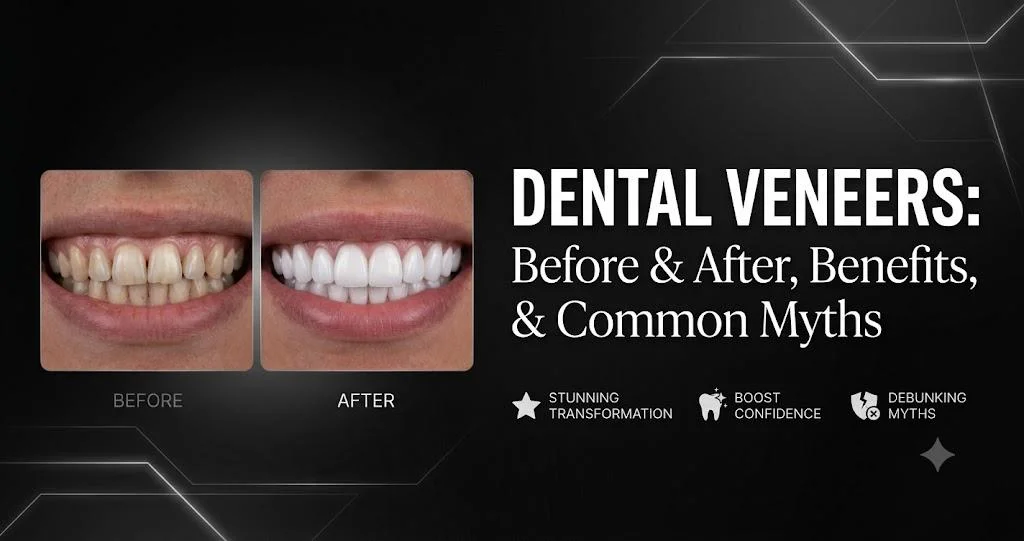
Many people hide their smile because of a chipped tooth, a stubborn stain or a small gap. Dental veneers are one of the most common ways dentists help with these concerns. This guide explains what veneers are, what treatment involves, what research says about how long they last, and how to decide if they suit you.
Table of Contents
What Are Dental Veneers?
Veneers are very thin shells attached to the outer surface of the tooth. Veneers are designed to be identical in terms of size, form and colour, as per the design by you and your dentist.
Two common types include:
- Porcelain veneers, sometimes called ceramic veneers, are made in a dental lab. They resist stains well and usually last the longest.
- Composite veneers are made from a tooth-coloured resin. They cost less and can often be done in one visit, but they tend to stain and wear sooner.
In a randomised trial that followed patients for up to 10 years, all of the porcelain veneers were still in place, compared with 75% of the lab-made composite veneers. The composite veneers also scored lower on colour match, smoothness and wear.1
Dentists commonly use veneers for:
- Stains that do not improve with whitening
- Chipped or worn teeth
- Small gaps between teeth
- Teeth that are slightly uneven or oddly shaped
Dental Veneers Before and After: What Can You Expect?
Porcelain veneers usually take two to three visits over a few weeks.
Before Veneers
Your first visit is a consultation. Your dentist will check your teeth and gums, look for decay, and ask whether you grind your teeth. X-rays, photos and scans are usually taken.
This is also when you talk about the look you want. Many clinics can place a temporary trial version over your teeth so you can see the result first. Any cavities or gum disease are treated before veneers are placed.
During Treatment
Your dentist numbs the area and removes a very thin layer from the front of each tooth, usually less than a millimetre, so the veneer does not look bulky. Research shows veneers remove roughly 3% to 30% of the visible tooth structure, while full crowns remove around 63% to 72%.2
A scan is sent to the lab, and you may wear temporary veneers for one to two weeks. At the next visit, your dentist checks the fit and colour, bonds each veneer in place with a dental adhesive, hardens it with a curing light, then trims and polishes the edges. Composite veneers are shaped directly on your teeth in a single visit.
After Veneers
Your teeth may feel a little different at first, but most people get used to them within a few days. Mild sensitivity to hot or cold is common for a short time. The change in appearance is usually clear right away, with brighter, more even teeth. A follow-up visit lets your dentist check your bite and gums.
Benefits of Veneers
Dental veneers have the ability to enhance the colour, shape, and general aesthetics of your teeth while maintaining most of their original structure. The following are some advantages that you should consider:
- Looks natural: Porcelain can be matched closely to the colour and shape of your surrounding teeth.
- Lasts longer: A review of 25 studies covering 6,500 porcelain veneers estimated that 95.5% were still working after 10 years.3
- Resists stains: Porcelain does not easily absorb stains from tea, coffee or red wine.
- Saves more of your natural tooth: Unlike crowns, veneers usually require only a thin layer of enamel to be removed, so more of your natural tooth structure remains.
- Fixes several problems: One set of veneers can deal with colour, shape, chips and small gaps together.
Common Dental Veneer Myths - Fact vs Reality
There is a lot of conflicting information about veneers. Here are some of the most common myths, along with what you should actually know before deciding on treatment.
|
Myth |
Reality |
|
Veneers always look fake. |
Poorly planned veneers can look unnatural. Well-planned veneers are designed to suit your face, gums and surrounding teeth. |
|
Veneers ruin your natural teeth. |
Only a small amount of enamel is usually removed, but the process is permanent, and the tooth will always need a veneer. |
|
Veneers don't last. |
Porcelain veneers can last 10 years or longer with proper care, with many lasting 20 years or more.3, 4 |
|
Teeth under veneers can't get cavities. |
The natural tooth around a veneer can still decay, so brushing and flossing remain important. |
|
You can whiten veneers later. |
Whitening does not change porcelain. If needed, whiten your natural teeth before choosing your veneer shade. |
Are Dental Veneers Right for You?
Veneers may suit you if your teeth and gums are healthy, you have enough healthy enamel, and you want to fix stains, chips, gaps or uneven shapes. They may not be the best option if:
- You have active gum disease or untreated decay.
- You grind or clench your teeth heavily.
- Your teeth are badly crooked. Braces or clear aligners may work better.
- A tooth has a large filling or little healthy structure left. A crown may be stronger.
Key Things to Know Before Getting Veneers
- The process is usually permanent. Removed enamel does not grow back.
- Veneers may need replacing one day. Chipping is the most frequent issue reported, followed by veneers coming loose, and both tend to happen in the first few years.
- Porcelain costs more than composite. Ask your dentist how long each option is likely to last for you.
- Your dentist's experience matters. Ask to see before-and-after photos of their own patients.
- Some habits need to change. Avoid biting nails, chewing pens or ice, and opening packets with your teeth.
- Regular check-ups help. Brush twice a day with a non-abrasive toothpaste, floss daily, and see your dentist every six months.
If you are considering veneers, a good first step would be a dental consultation. A dentist will be able to examine your teeth, provide answers and help you make the right decision.
FAQs
- Do dental veneers look natural?
Dental veneers made out of porcelain imitate the translucent properties and the colour variation of real tooth enamel in appearance. Your dentist will make sure that the veneers match your own facial characteristics and teeth colouration. When done wrong, these veneers appear very artificial, but when done right, they blend well with your teeth.
- Do veneers damage your natural teeth?
Veneers do not ruin your teeth, but the procedure does require removing a very thin layer of surface enamel, typically under one millimetre. This minor preparation is necessary so the veneers fit flat without looking bulky. Because lost enamel cannot regenerate, the underlying natural tooth structure is altered and will permanently require a protective restoration.
- Are dental veneers permanent?
Yes, the overall process is considered permanent because the dentist must shave down a small amount of natural enamel to place them. While individual veneers will eventually need replacement due to normal wear and tear over time, your prepared teeth will always require some form of coverage, such as a new veneer or a crown.
- How long do dental veneers last?
With good care and proper oral hygiene, the lifetime of porcelain veneers is approximately ten to twenty years. The lifetime of composite veneers is generally five to seven years. This can be increased by avoiding practices such as biting down on hard objects, teeth grinding, and using one's teeth as tools.
- Can veneers fix crooked or uneven teeth?
The problem of mild crookedness, gaps, and minor shape irregularities can be covered up by veneers. This is why they are known as "instant orthodontics". But veneers do not move the teeth into place. For severely crooked teeth, pronounced gaps, or major bite issues, orthodontic treatments like traditional braces or clear aligners are necessary before considering cosmetic veneers.
- Can you eat normally with dental veneers?
Once fully bonded, you can eat most of your favourite foods normally and comfortably. However, it is important to avoid chewing very hard or tough foods with your front teeth, especially those that have been fitted with veneers. Examples of such foods include ice, hard candy, raw bones, and nuts.
- Are porcelain veneers better than composite veneers?
Porcelain veneers have better strength, stain resistance, and appearance. This is why they are considered better investments in the long term. Porcelain veneers can last for more than a decade. On the other hand, composite veneers are relatively inexpensive and can be done in one visit. However, they are easier to stain and chip, and need replacing after a few years.
References
- M. M. M. Gresnigt, M. S. Cune, K. Jansen, S. A. M. van der Made, and M. Özcan, "Randomized Clinical Trial on Indirect Resin Composite and Ceramic Laminate Veneers: Up to 10-Year Findings," Journal of Dentistry 86 (2019): 102–9, https://www.sciencedirect.com/science/article/abs/pii/S0300571219301253.
- Daniel Edelhoff and John A. Sorensen, "Tooth Structure Removal Associated with Various Preparation Designs for Anterior Teeth," Journal of Prosthetic Dentistry 87, no. 5 (2002): 503–9,
https://www.thejpd.org/article/S0022-3913(02)00007-0/abstract. - Ali Alenezi, Mohammad Alsweed, Saleh Alsidrani, and Bruno R. Chrcanovic, "Long-Term Survival and Complication Rates of Porcelain Laminate Veneers in Clinical Studies: A Systematic Review," Journal of Clinical Medicine 10, no. 5 (2021): 1074,
https://www.mdpi.com/2077-0383/10/5/1074. - Beier, Ulrike Stephanie, Ines Kapferer, Doris Burtscher, and Herbert Dumfahrt. “Clinical Performance of Porcelain Laminate Veneers for Up to 20 Years.” International Journal of Prosthodontics 25, no. 1 (2012): 79–85. https://pubmed.ncbi.nlm.nih.gov/22259802/.
-
Other Blogs
- The Science Behind Smile Makeovers: What You Should Know
- Are Dental Implants and Metal-Ceramic Crowns Safe During an MRI?
- How Long Do Veneers Really Last?
- Why Do Dental Implants Fail? Causes, Warning Signs & How to Prevent It
- How Do I Know If I Need a Full Mouth Rehabilitation? A Comprehensive Clinical Guide
- All-on-4 vs All-on-6 Dental Implants: Which Is Right for You?
Make an Appointment
-
Other Blogs
- What Happens If Half of Your Tooth Breaks Off?
- The Benefits of Dental Implants
- Have Missing Teeth? Here is all that you need to know about getting the smile you wanted.
- Managing a Sore Throat Caused by Allergies: Effective Strategies for Relief
- Do’s and Don’ts Post Root Canal Treatment, Best Root Canal Treatment in Delhi
- Advice on How to Smile Your Best
- Dental Implants: Aware of 4 Early Complications
- Oral Health and Cognitive Defense: The Connection Between Dental Care and Dementia Prevention
- My Adult Tooth is Loose! What Should I Do? A Dentist's Emergency Guide
- When Is the Best Time for a Dental Implant?
- How Smile Makeover Leaves A Positive Impact On Your Life?
- How to Stabilize Loose Teeth: Causes, Treatment, and Prevention
- Teeth Falling Out? Urgent Steps & Expert Solutions at Dent Ally
- What is the most natural tooth replacement?
- What To Consider Before Getting Braces?
- Unlocking the Secrets to a Radiant Smile: Lifestyle Choices for Optimal Dental Health
- How To Select The Perfect Fillings For Your Teeth?
- 😁 What is the Cost of Invisalign in India?
- What is the most affordable way to replace missing teeth?
- The Impact of Bruxism (Teeth Grinding) on Your Dental Health
- Abscess in Gums: How to Treat It Effectively
- The Future of Restorative Dentistry: How 3D CBCT Imaging and Computer-Guided Surgery Make Dental Implants Safer
- Plaque vs. Tartar: What’s the Difference and Why Does It Matter for Your Health?
- Can Stress Affect My Teeth
- Why Is It A Necessity To Choose A Right Dentist?
- Can You Fully Recover From Gum Disease? A Comprehensive Guide
- Nurturing Healthy Smiles: The Power of Positive Habits for Dental Wellness
- Effective Practices To Keep Your Teeth Healthy
- Bleeding Gums When Flossing: Should You Call Your Dentist?
- Exploring Affordable Dental Implants: The Cheapest Countries for Your Dental Health
- Bleeding Gums - What To Do?
- Dental Implants And How Crucial Replacing Teeth Really Are?
- Mastering Oral Hygiene: A Comprehensive Guide to Healthy Teeth and Smiles
- What To Eat After Dental Implant Surgery
- The Repercussions Of Neglecting A Tooth Pain
- Can a dental implant be done in one day?
- How to Fix Broken Teeth: A Comprehensive Guide
- Is Popcorn Bad For Your Teeth? The Hidden Dangers of a Movie Snack
- Does Tooth Implant Have Side Effects? Understanding the Risks and Benefits 🦷⚖️
- Dental Crowns – Types, Cost And Their Longevity
- What differentiates cosmetic dentistry from normal dentistry?
- Dental Implant – Procedure, Types, And Cost Associated
- Is Teeth Whitening Safe?
- Can Dental Problems Cause Headaches?
- Selenomonas sputigena: A New Player in Tooth Decay
- Dental Implants for Diabetic Patients in India: A Guide to Safe & Successful Treatment
- Get The More Information On Dental Implants
- How Long Do Crowns Last on Front Teeth?
- Smoking and Its Detrimental Effects on Dental Health
- Preview Your Perfect Smile Before Treatment Even Starts