


All-on-4 vs All-on-6 Dental Implants: Which Is Right for You?
Medically Reviewed by Dr. Shashi
Losing a full arch of teeth—or facing the extraction of terminal teeth—is a major life event. Beyond the immediate impact on chewing function and speech, full-arch tooth loss leads to progressive jawbone resorption, changes in facial structure, and diminished self-confidence.
For decades, removable dentures were the primary solution. However, modern implantology offers fixed, permanent alternatives that look, feel, and function like natural teeth. The two most reliable and scientifically proven options for full-arch restoration are All-on-4 and All-on-6 dental implants.
If you are evaluating full-mouth rehabilitation, choosing between these two treatment modalities can feel overwhelming. This comprehensive guide breaks down the biomechanics, surgical nuances, candidate selection criteria, and long-term expectations for both systems.
What Are Full-Arch Implant Concepts?
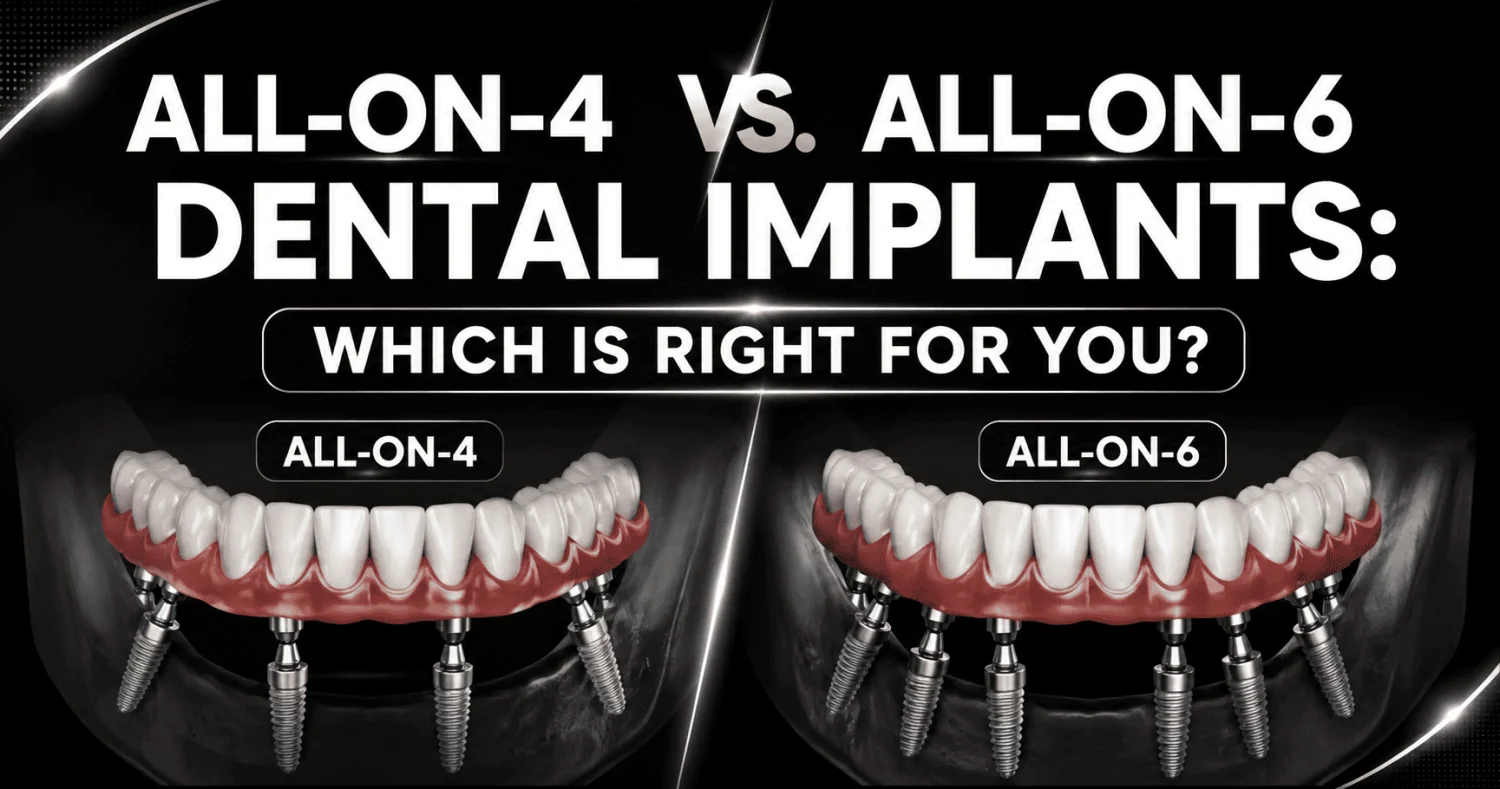
Both All-on-4 and All-on-6 are fixed full-arch rehabilitation techniques designed to support an entire bridge of replacement teeth (10 to 14 teeth per jaw) using a strategic number of titanium implant posts.
Rather than placing an individual implant for every missing tooth—which is surgically invasive, costly, and often anatomically impossible due to bone loss—these techniques utilize strategic load distribution. By anchoring a rigid, full-arch prosthesis onto 4 or 6 precisely positioned implants, suitable patients can receive an immediately stable provisional bridge, with chewing function restored progressively during healing.
Detailed Comparison: All-on-4 vs. All-on-6
While both systems eliminate the instability and palate-covering bulk of traditional dentures, they differ significantly in biomechanics, bone requirements, and structural force distribution.
|
Feature / Criteria |
All-on-4 Dental Implants |
All-on-6 Dental Implants |
|
Number of Implants |
4 titanium implants per arch |
6 titanium implants per arch |
|
Posterior Implant Angle |
Angled up to 30°–45° to maximize existing bone |
Generally straight (parallel) or slightly tilted |
|
Bone Density Requirement |
Adequate bone for stable placement; assessed individually |
Adequate bone for six stable fixtures; assessed individually |
|
Bone Grafting Needed? |
May avoid grafting in suitable cases |
Grafting may be needed if available bone is insufficient |
|
Bite Force Distribution |
Concentrated across 4 primary load points |
Broadly distributed across 6 load points |
|
Prosthetic Cantilever |
Longer prosthetic posterior cantilever |
Shorter cantilever, reducing distal lever forces |
|
Primary Indication |
Full-arch tooth loss with suitable anterior bone |
Heavy bite force, broad arches, sufficient bone width |
1. The All-on-4 Concept Explained
Pioneered by Dr. Paulo Maló in collaboration with Nobel Biocare, the All-on-4 concept is engineered to rehabilitate completely edentulous (toothless) jaws without requiring extensive bone grafting.
How It Works Biomechanically
In an All-on-4 placement:
- Two Anterior Implants are placed vertically in the front of the jaw, where bone density is naturally higher.
- Two Posterior Implants are placed in the back of the jaw and tilted at an angle of 30° to 45°.
Why Angle the Implants?
Angling the posterior implants serves two vital anatomical functions:
- Avoids Critical Structures: It bypasses the maxillary sinus cavities in the upper jaw and the inferior alveolar nerve in the lower jaw, potentially reducing the need for sinus lift procedures or nerve transposition.
- Maximizes Bone Contact: Tilting the implant embeds it in denser anterior bone and provides a wider anteroposterior (A-P) spread. This wide base supports a rigid, fixed bridge with minimal cantilever stress.
2. The All-on-6 Concept Explained
The All-on-6 treatment protocol follows similar principles of full-arch fixed restoration but introduces two additional implants to distribute occlusal (chewing) forces more evenly.
How It Works Biomechanically
By placing six implants throughout the anterior, premolar, and molar regions, the system creates a wider structural arch perimeter.
Advantages of the 6-Implant Matrix
- Enhanced Load Distribution: Bite forces—especially grinding and heavy mastication—are spread across six points rather than four.
- Redundancy and Security: In the rare event of peri-implantitis or an isolated implant failure years down the road, a 6-implant framework provides structural redundancy. The arch can often be saved or modified without rebuilding the entire prosthesis.
- Shorter Cantilevers: Adding posterior implants allows the prosthetic teeth to extend further back toward the molars without creating unstable overhangs (cantilevers).
Clinical Insights & Treatment Planning at Dent Ally
At Dent Ally, full-mouth rehabilitation is never approached with a "one-size-fits-all" mindset. The decision between All-on-4 and All-on-6 is governed by precise, evidence-based diagnostic metrics rather than arbitrary selection.
1. What We Look for During Diagnosis
During your initial evaluation, our multidisciplinary team of prosthodontists and implantologists evaluates several key anatomical parameters:
- 3D Bone Volume & Density (CBCT Analysis): We utilize Cone Beam Computed Tomography (CBCT) to measure bone height, width, and the available bone anatomy for implant planning. If posterior bone height is severely compromised, All-on-4 is often a possible graft-avoiding option. If bone density and width are robust, All-on-6 may offer additional support.
- Jaw Arch Size & Shape: Patients with square, broad jaw arches exert higher mechanical leverage during chewing. These cases benefit significantly from six implants. Patients with smaller, V-shaped arches may not have room for six implants without crowding them, making four implants the anatomically correct choice.
- Antagonist Arch & Bruxism: We evaluate what the new teeth will bite against. If you bite against natural teeth or heavy zirconia restorations—or if you show signs of night-time teeth grinding (bruxism)—the additional surface area of All-on-6 may help distribute these loads, alongside careful bite planning and bruxism management.
2. Common Mistakes Patients Make
Over years of treating complex rehabilitation cases, our specialists frequently address a few common patient misconceptions:
- Misconception 1: "More implants are always better." Placing 6 or 8 implants into a narrow jaw with insufficient bone spacing can compromise blood supply between fixtures, leading to bone resorption and peri-implantitis. The quality and precise 3D positioning of an implant matter far more than total count.
- Misconception 2: "I should pick the option purely based on cost." Choosing All-on-4 when your bite mechanics require All-on-6 can lead to prosthetic fractures over time. Conversely, paying for unnecessary bone grafts just to force six implants into a depleted jaw adds cost and healing time without clinical benefit.
- Misconception 3: "Immediate teeth mean I can eat hard food right away." While immediate provisional teeth allow you to smile and speak comfortably on day one, the underlying jawbone typically requires several months to undergo osseointegration (fusion with the titanium posts). Eating hard or crunchy foods during this bone-healing phase can disrupt bone bonding.
Patient Journey: What to Expect
Understanding the clinical workflow helps eliminate anxiety and prepares you for a predictable recovery.
Step 1: Digital Consultation & 3D Planning
Your journey begins with digital diagnostics, including high-resolution 3D CBCT imaging and intraoral 3D scans. Using virtual implant planning software, our implantologists simulate the exact placement depth, angle, and trajectory of every fixture before entering the surgical suite.
Step 2: Computer-Guided Surgical Placement
On the day of surgery, static surgical guides generated from your 3D plans are placed over the gums. The implants (such as premium Straumann or Nobel Biocare systems) are inserted with sub-millimeter precision. If extracting remaining failing teeth, extractions and implant placements may be performed in the same surgical session when clinically appropriate.
Step 3: Immediate Provisional Loading ("Same-Day Teeth")
If primary implant stability thresholds are met (measured via Insertion Torque or Implant Stability Quotient), a temporary, fixed acrylic bridge is attached directly to the implants. You leave the clinic with a complete, functional set of non-removable teeth on the same day.
Treatment sequence: diagnostics and guided surgery; provisional fixed bridge if suitable; several months of healing; final restoration.
Step 4: Osseointegration & Final Restoration
Over the next 12 to 16 weeks, the titanium posts fuse securely with your jawbone. Once osseointegration is confirmed, high-precision impressions are taken to fabricate your final, permanent restoration. Options range from high-impact monolithic Zirconia to titanium-reinforced Prettau bridges, customized for natural aesthetics and optimal bite alignment.
Practical Maintenance: Caring for Full-Arch Implants
Although implant restorations cannot develop cavities, maintaining the surrounding gum and bone tissue is vital to prevent peri-implantitis.
- Water Flossers (Oral Irrigators): Use a water flosser daily on a medium setting to clear food debris from beneath the prosthetic bridge.
- Super Floss & Interdental Brushes: Thread specialized floss beneath the bridge once daily to clean around each multi-unit abutment.
- Professional Maintenance: Visit your dental team every 6 months for professional hygiene checks and bite evaluations. Your clinician will decide whether the bridge needs removal for cleaning, repair, or component checks.
Frequently Asked Questions
Q1: What is the main difference between All-on-4 and All-on-6 dental implants?
Answer: The primary difference lies in the number of implants used and how bite forces are distributed across the jawbone. All-on-4 uses four titanium implants per arch—with the back two tilted at 30° to 45° to maximize available bone without grafting. All-on-6 uses six implants placed straight or slightly angled across a broader arch perimeter, providing greater support and load distribution for patients with adequate bone density or strong bite forces.
Q2: Is All-on-6 better than All-on-4?
Answer: Not necessarily. Neither system is universally "better"—the right choice depends entirely on your jawbone density, arch size, and bite mechanics. All-on-6 provides additional stability and structural redundancy for wide arches and heavy chewing forces. However, All-on-4 is often the preferred, anatomically correct choice for patients who have experienced significant bone loss and wish to avoid extensive sinus lift or bone grafting surgeries.
Q3: Is the full-arch dental implant procedure painful?
Answer: Anesthesia is used to control pain. The surgical placement of both All-on-4 and All-on-6 implants is performed under local anesthesia, conscious sedation, or general anesthesia, according to individual clinical needs. Post-operative swelling or mild soreness is normal for 3 to 5 days following surgery and is easily managed with prescribed anti-inflammatory medications.
Q4: Can I get fixed teeth on the same day as surgery?
Answer: Yes. If the implants achieve sufficient primary stability during insertion (measured via insertion torque), a provisional, non-removable bridge can be attached on the same day as your surgery. This allows you to eat the recommended soft foods, speak, and smile while the implants undergo complete osseointegration over the next 3 to 4 months before your final permanent restoration is placed.
Q5: How long do All-on-4 and All-on-6 dental implants last?
Answer: With proper oral hygiene, daily water flossing, and regular professional dental check-ups, the titanium implant posts integrated into your jawbone are designed to last a lifetime. The prosthetic bridge attached to the implants may undergo normal wear over 10 to 15 years and can easily be serviced, polished, or refurbished without removing the underlying implants.
Q6: What affects the cost of All-on-4 and All-on-6 implants?
Implant number, the prosthetic material, any grafting, and the number of arches treated affect dental implant cost. Ask for an itemized plan covering temporary teeth, the final bridge, and follow-up care.
Making Your Decision
Choosing between All-on-4 and All-on-6 comes down to your unique jaw anatomy, bone density, bite force, and long-term oral health goals. Both procedures offer transformative results, freeing you from loose dentures and restoring complete chewing ability.
If you are evaluating full-mouth rehabilitation in Northern India, seeking care at the best dental clinic in delhi ensures access to internationally trained implantologists, advanced 3D guided surgery, and personalized, specialist-led treatment planning.
Clinical Reference & Care Center
Dent Ally - Center for Advanced, Digital & Microscopic Dentistry
Recognized for excellence in computer-guided implantology, full-mouth rehabilitation, and multi-specialty care.
- Clinical Focus: 3D Guided Implant Surgery, All-on-4/All-on-6 Restorative Protocols, Digital Smile Design, Full Mouth Rehabilitation.
- Quality & Safety Standards: Internationally trained specialists (MDS), Class B vacuum autoclaves, hospital-grade sterilization protocols, and comprehensive patient warranties.
-
Other Blogs
- Dental Veneers: Before & After, Benefits, and Common Myths
- The Science Behind Smile Makeovers: What You Should Know
- Are Dental Implants and Metal-Ceramic Crowns Safe During an MRI?
- How Long Do Veneers Really Last?
- Why Do Dental Implants Fail? Causes, Warning Signs & How to Prevent It
- How Do I Know If I Need a Full Mouth Rehabilitation? A Comprehensive Clinical Guide
Make An Appointment
-
Other Blogs
- The Repercussions Of Neglecting A Tooth Pain
- What Is The Importance Of The Dental Clinic In India?
- FAQs On Root Canal Procedure
- How Much Does It Cost to Fill the Gap in Your Teeth? 🦷💸
- Can I Wait 6 Months to Fill a Cavity? Understanding the Risks and Consequences
- How Ignorance Devastated A Woman’s Married Life
- The Vital Role of Oral Hygiene in Daily Life: A Path to Healthier Living
- WHY IS CHILDREN’S DENTAL CARE EXTREMELY IMPORTANT, Best Child Dentist in Delhi
- Fall Superfoods for Your Teeth
- Dentist for Pregnant Women Near Me: Why Dental Care During Pregnancy is Crucial
- 😁🦷 Clear Aligners for Teeth: The Modern Way to Straighten Your Smile in India
- The Art of Smile Transformations: Crafting Stunning Smile Makeovers at Dentally.in
- New Revolutionary Way to Keep Your Mouth Healthy
- Navigating Invisalign: Addressing Pain and Discomfort with Comfort and Confidence
- Why Choose Dent Ally for Clear Aligners in India?
- How much does full mouth rehab cost in India?
- How Much Does Root Canal Treatment Cost in India?
- How To Prepare Yourself For Dental Implant Surgery Mentally?
- When Is the Best Time for a Dental Implant?
- Sleep Apnea and Oral Health: How Your Dentist Can Help
- Dental Implant Complications: Understanding Risks and Navigating Safe Practices in India
- 3 Reasons Why You Shouldn’t Feel Jittery About Dental Implants
- The Future of Restorative Dentistry: How 3D CBCT Imaging and Computer-Guided Surgery Make Dental Implants Safer
- Dental Erosion: What You Need To Know
- All You Need To Know About Visiting The Dentist When You're Pregnant
- Can I Eat Maggi After Tooth Extraction?
- 🦷 How Oral Health Affects Your Well-Being: 6 Reasons Why Good Dental Care Matters
- Everything You Need To Know About Dental Implant
- 4 Tips To Maximize The Benefits Of Use Of A Dental Floss
- Dental Implants: Aware of 4 Early Complications
- How Do I Know If I Need a Full Mouth Rehabilitation? A Comprehensive Clinical Guide
- The Surprising Answer: Which Sport Has the Highest Rate of Dental Injuries?
- ✈️ Top 5 Reasons Canadians, Australians & Americans Fly to India for Dental Implants
- Plaque vs. Tartar: What’s the Difference and Why Does It Matter for Your Health?
- Sterilization & Infection Control Protocol
- 3 Causes Of Throbbing Tooth Pain You Need To Know
- Got the biggest solitaire but still feel something is missing?
- Best and Effective Tips for Teeth Whitening Process
- What to Do When You Have a Painful Cavity
- 5 Ways To Keep Your Dental Implant Clean And Hygienic
- How Remote AI Monitoring is Reducing Dental Chair Time for Invisalign Patients
- Smoking and Its Detrimental Effects on Dental Health
- Best Countries for Dental Implants in 2026: A Comprehensive Guide
- Braces Treatment : Why, When and How
- The Importance of Regular Dental Check-ups: A Key to Oral Health
- How To Get Rid of Sensitive Teeth
- What to do When Your Tooth Falls Out
- Dental Implants for Diabetic Patients in India: A Guide to Safe & Successful Treatment
- Dental Braces – Know Their Significance And Risks
- Can Oral Health Impact Mental Health? The Surprising Connection